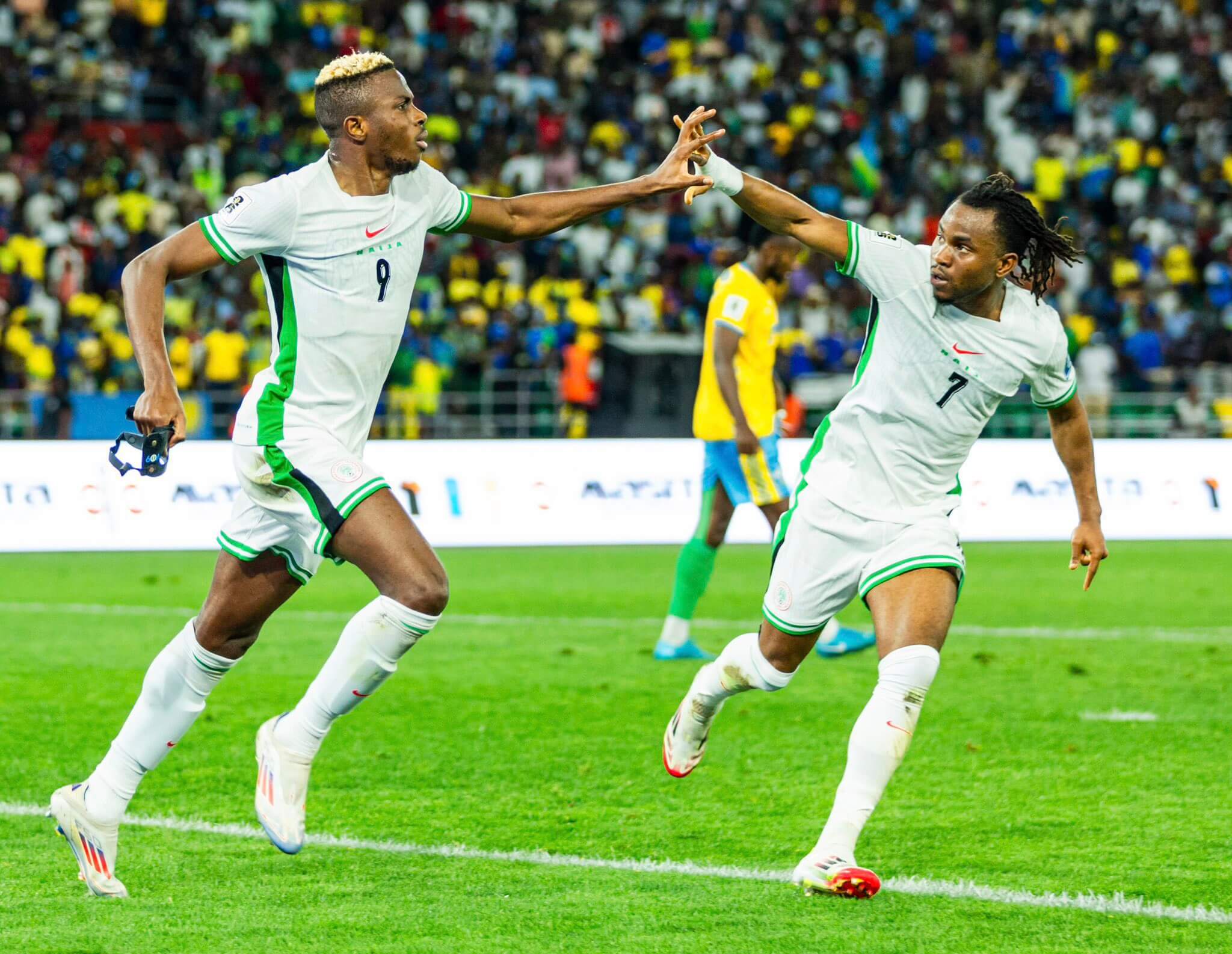


Anyone who watched the match between the Super Eagles of Nigeria and the Cheetahs of Benin Republic on October 14 would agree that Nigeria finally came alive. The Super Eagles delivered a commanding performance, scoring twice in the first half and twice again in the second to seal a 4–0 victory that reminded fans of the team’s true potential.
It was a game that saw Victor Osimhen bag a hat-trick and Frank Onyeka add the fourth, in what felt like the performance Nigerians had been waiting for all campaign.
Despite the emphatic win, it wasn’t enough to secure automatic qualification for the 2026 FIFA World Cup. Nigeria needed South Africa to either lose or draw their match against Rwanda, but the Bafana Bafana held firm, cruising to a 3–0 win that ensured they topped Group C and booked their ticket to North America.
For Nigeria, that result means the dream isn’t over, but it’s no longer simple.
Many Nigerian fans are understandably frustrated. Some have argued that this level of intensity came too late in the qualifiers. If the team had played with this same hunger earlier, there would have been no need for last-minute mathematics and prayers.
When the draws for the 2026 FIFA World Cup African qualifiers were made in July 2023, not many imagined that Nigeria, three-time winner of the Africa Cup of Nations (AFCON), would be fighting for survival at this final stage.
Group C, which featured South Africa, Benin Republic, Lesotho, Rwanda, and Zimbabwe, was seen as one of the more manageable groups. On paper, only South Africa looked like a genuine challenge. Yet, as the qualifiers draw to a close, reality tells a very different story.
The Super Eagles, once considered the clear favourite, now stand at a crossroads, depending on mathematics, a bit of luck, and prayers to keep their World Cup dream alive.
So, where exactly does Nigeria stand now, and what does this 4–0 win really mean going forward?
To understand this, let’s start from the beginning.
What’s up with the CAF qualification format?
If this World Cup qualifying round has felt unusually tense, that’s because it is. The 2026 tournament has introduced the toughest qualification format Africa has ever seen, and for once, even the big names can’t afford a single off day.
Here’s the setup:
Africa has been allocated nine automatic World Cup slots, with a tenth team still having a shot through an intercontinental playoff. That sounds generous, until you realise that 54 countries are fighting for those places.
To make it work, CAF split the continent into nine groups of six, with each team playing ten matches, home and away. Only the team that finishes top of each group qualifies outright.
For the rest, it gets tricky.
The second-placed teams are compared across all nine groups to determine who goes into a special CAF playoff. But because Eritrea pulled out of Group E earlier in the campaign (leaving that group with five teams instead of six), CAF decided that to keep things fair, results against the bottom team in each six-team group would be ignored when ranking second-placed sides.
That means Nigeria’s big 4–0 win, while important, may not have counted in full if it came against the group’s lowest-ranked team. It’s a system designed to balance the numbers, but it also adds one more layer of uncertainty to the drama.
To make matters even messier, a FIFA disciplinary ruling earlier in the qualifiers docked South Africa three points for fielding an ineligible player, Teboho Mokoena. The points were handed to Lesotho, briefly reshuffling Group C’s standings and keeping Nigeria’s campaign alive longer than many expected.
So, while the road to North America might look straightforward in theory (finish first and you’re in, finish second and you fight for a lifeline), the reality is far more unforgiving. It’s a format that rewards consistency and punishes hesitation.
For a team like Nigeria, that started slow and found form only at the tail end, that unforgiving edge has made all the difference.
Where Nigeria stands now
Nigeria’s 4–0 win over Benin Republic couldn’t have come at a better time. It has kept the Super Eagles in the World Cup qualifier race.
After ten matches, Nigeria sits second in Group C with 17 points, a precarious position, yes, but one that fortunately offers many possibilities.
Here’s why.
While most of the other second-placed teams across CAF’s nine groups padded their tallies by beating up on the bottom sides, Nigeria stumbled, managing only two points against Zimbabwe, who eventually finished last in Group C.
When ranking all nine runners-up for playoff spots, CAF’s rules dictate that the results against the bottom team in each group don’t count. So once those Zimbabwe results are stripped out, Nigeria drops to 15 points, but crucially, their superior goal difference keeps them inside the playoff bracket.
That 4–0 win saved the campaign for Nigeria and sealed their place in the upcoming CAF playoffs, joining Cameroon, DR Congo, and Gabon as Africa’s four best second-placed teams.
How the CAF Playoffs Work
The four playoff teams will be drawn into two semifinal pairs, each playing a single knockout match. Nigeria will face one of the other runner-ups. The two winners will then meet in a final playoff, and the eventual winner moves on to the FIFA intercontinental playoffs.
For Nigeria, that means two must-win games stand between them and another shot at qualifying. Win both, and the Super Eagles become Africa’s representative on the global playoff stage.
The draw, which will be based on the FIFA Rankings, will be released on October 23, 2025. Afterwards, the semi-finals are scheduled for November 13, 2025, while the final will take place on November 16, 2025. Both matches will be held in Morocco.
Next stop: The FIFA Intercontinental Playoffs
Here’s where things get really interesting. The intercontinental playoffs bring together six teams from across the world:
- 1 team from Africa (Confederation of African Football, CAF).
- 1 team from Asia (Asian Football Confederation, AFC).
- 1 team from South America (Confederación Sudamericana de Fútbol, CONMEBOL)
- 1 team from Oceania (Oceania Football Confederation, OFC)
- 2 teams from North and Central America (Confederation of North, Central American and Caribbean Association Football, CONCACAF), which is the host confederation.
The six sides will be ranked by FIFA’s World Rankings. The top two will be seeded and skip straight to the final stage, while the other four play single-leg semifinals.
The semifinal winners then face the seeded teams in two final playoff matches, and the two winners of those games will claim the last two tickets to the 2026 FIFA World Cup.
Nigeria’s chances
At 45th in the latest FIFA rankings, Nigeria is currently positioned to earn one of those seeded spots, especially since confirmed playoff entrants like Bolivia (CONMEBOL) and New Caledonia (OFC) sit below them. That could prove decisive, as skipping the semifinal means fewer games, less travel, and a clearer path to qualification.
Still, it’s a marathon, not a sprint. The CAF playoffs kick off in the November international window, and only then will we see if Nigeria’s late revival was the start of a redemption arc or just a brief reprieve.
Either way, the stakes couldn’t be higher. The journey from Uyo to North America has never been more demanding, but for a team with Nigeria’s talent, I believe it’s still entirely within reach.